
Topic 1. Java Basics
This chapter is introductory, but the goal is practical clarity rather than short definitions. You should leave it with a working mental model: where Java is used, how source code becomes a running process, why teams still choose it for large systems, and what tradeoffs come with that choice.
Java is dominant in domains where software must be maintained for years: banking, telecom, logistics, enterprise platforms, public sector systems, and large-scale backend services. In those environments, long-term predictability is more valuable than short-term syntax convenience. Java's ecosystem was shaped around exactly that requirement.
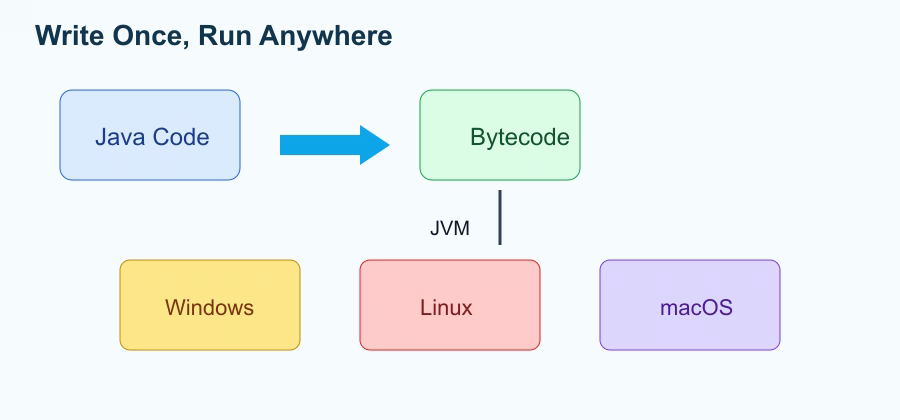
The multiplatform statement is often simplified as “write once, run anywhere”, but the mechanism matters. You write .java source files, compile them into bytecode (.class), and execute that bytecode on JVM implementations for specific operating systems. Business logic remains the same while runtime adaptation happens in the platform layer.
A minimal program already shows core Java design principles.
public class HelloJava {
    public static void main(String[] args) {
        int year = 2026;
        System.out.println("Hello, Java " + year);
    }
}
This small snippet demonstrates class-based structure, explicit entry point, static typing, and deterministic execution flow. Real applications scale this pattern, they do not replace it.
Output:
Hello, Java 2026
Java strengths are especially visible in team environments: mature tooling, stable libraries, strong IDE support, clear build pipelines, and broad operational experience in industry. This reduces delivery risk because many architectural problems already have battle-tested solutions and patterns.
Tradeoffs are real too. Java can feel verbose in small scripts. Beginners often need more time to understand ecosystem conventions. Poorly designed projects can become over-abstracted and hard to navigate. In short, Java is powerful at scale, but it rewards engineering discipline.
Robust and Secure in Java is not a slogan. It is a combination of strict typing, bytecode verification, controlled class loading, exception handling conventions, and runtime isolation mechanisms that help teams reduce dangerous classes of bugs.
Multithreaded means concurrency is native to the platform. Java standard library includes threads, executors, synchronization primitives, concurrent collections, and scheduling tools. For backend systems this is foundational, not optional.
Dynamic means runtime flexibility: reflection, dynamic class loading, proxies, and annotation-driven frameworks. That is how modern Java frameworks provide dependency injection, configuration, and behavior orchestration.
Practical takeaway: learn Java as a platform, not only as a syntax set. The earlier you connect language basics with runtime mechanics and architecture, the faster your code becomes production-grade.