
Stage 4 — Advanced Techniques
Advanced techniques are needed when a single prompt is not stable enough.
Stage topics
- Prompt chaining
- Self-reflection
- ReAct (Reason + Act)
- Tool usage / Function calling
- RAG (as part of multi-step architecture)
Why chaining beats one giant prompt
One long prompt is:
- harder to test,
- harder to debug,
- more fragile under small edits.
A chain of short steps is:
- more controllable,
- easier to monitor,
- easier to version and rollback.
Prompt chaining
Split workflow into stages:
- input normalization,
- classification/routing,
- response generation,
- post-validation.
Self-reflection
Model drafts an answer, then checks it against explicit constraints.
Important: self-reflection does not replace external validation, but reduces obvious failures.
ReAct
ReAct combines reasoning and action:
- plan,
- tool call,
- observation,
- correction.
Useful for agent-like workflows.
Tool usage and RAG
Advanced prompting is strongest when model can access:
- APIs,
- databases,
- files,
- search.
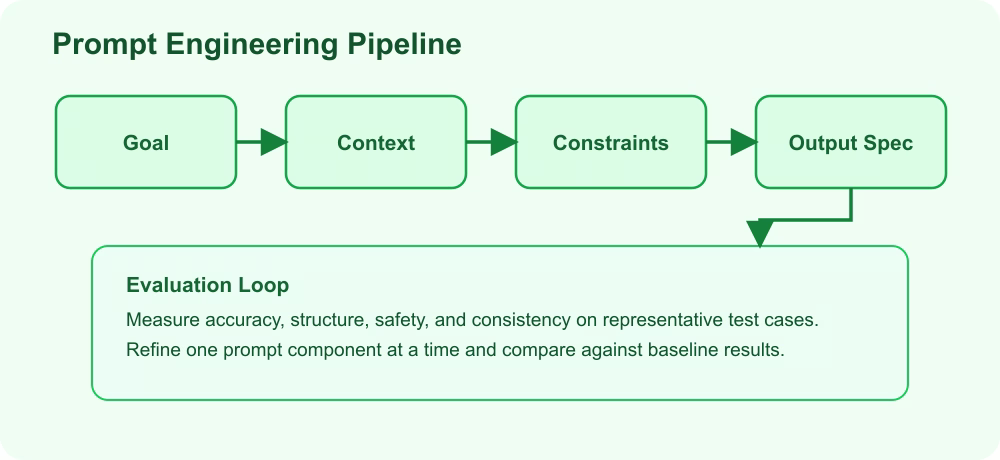
What control means in advanced workflows
Advanced prompting is not about making the model write longer reasoning. It is about controlling where decisions happen. A chain separates decisions into smaller stages, so each stage has a clear input, output, and validation rule. Self-reflection adds an internal review step, but it should still be checked by external code when correctness matters. ReAct adds actions, so it also adds risk: the model can call tools at the wrong time unless the prompt defines strict criteria.
Before using these patterns, define the workflow state. The system should know whether it is classifying, retrieving, drafting, validating, or executing. If those states are mixed in one prompt, debugging becomes difficult because there is no single place to inspect the failure.
| Technique | Best use | Required control |
|---|---|---|
| Prompt chaining | Multi-stage tasks | Stage input/output contracts |
| Self-reflection | Catching obvious constraint failures | External validation after review |
| ReAct | Tasks requiring observation and action | Tool-call criteria and limits |
| RAG | Source-bound factual work | Retrieval and citation checks |
What you must understand
- Why one giant prompt is worse than a controlled chain.
- How to connect external data/tools while preserving control.
Beginner explanation
Advanced techniques do not mean “make the model think longer”. They are useful when a task contains several different decisions. For example, a support bot may first classify the request, then retrieve documents, then draft an answer, then validate format and safety. If all of this is placed into one huge prompt, it is hard to know where the failure happened.
Prompt chaining splits the process into small steps. Each step has input and output. The first prompt may only classify the request. The second selects sources. The third writes a draft. The fourth checks that the answer follows rules. This workflow is easier to test: if classification is wrong, you do not need to rewrite answer generation.
Self-reflection is model self-checking against a checklist. For example, after drafting, the model may receive: “Check whether the answer contains unsupported claims, excessive confidence, or format violations.” But self-reflection does not replace backend validation. The model can miss its own mistake, so critical checks must be external.
ReAct is useful when the model can act: call search, an API, a calculator, or a database. You must define when tools may be called, which parameters are allowed, how many attempts are allowed, and what to do on failure. Without these rules, an agent may call tools too early, too often, or with wrong data.
Mini scenarios from real projects
- One giant prompt tries to solve 5 tasks and becomes unstable: quality improves after decomposition into a chain.
- Model makes a wrong middle-step decision: self-reflection over intermediate output reduces error.
- Tool usage is enabled but triggers unnecessary calls: criteria for tool invocation are not defined.
Fast decision rules
- If a task is multi-stage, split it into explicit steps with checkpoints.
- If error cost is high, add a self-review step before final output.
- Call tools only when external data or actions are explicitly required.
Self-check questions
- Why is a chain of smaller prompts often more reliable than one large prompt?
- Where should quality checkpoints be placed in a prompt chain?
- How do you keep ReAct from becoming chaotic tool overuse?